
Note: This page contains excerpts from Patrick Comerford’s article. Check the original text at this link.
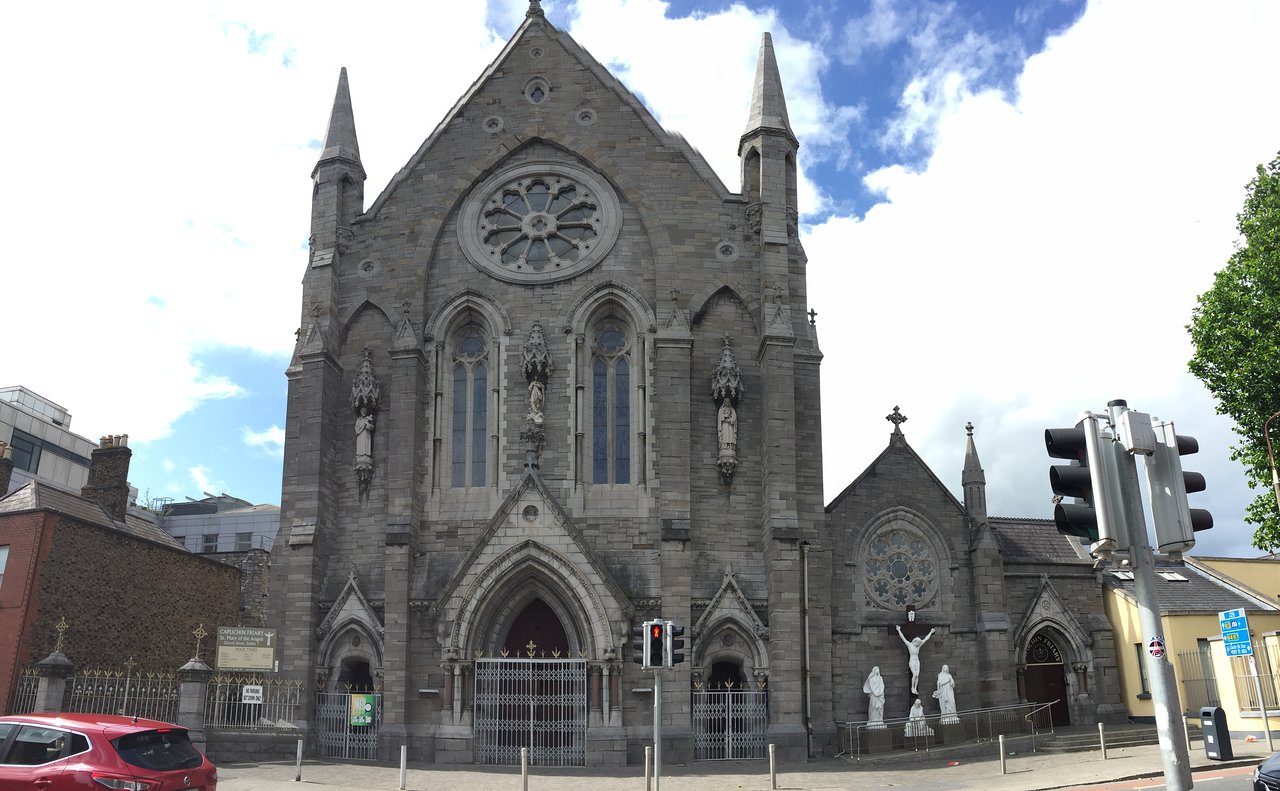
The Capuchin Church of Saint Mary of the Angels on Church Street, Dublin, was designed by JJ McCarthy and built between 1866 and 1882 (Photograph: Patrick Comerford, 2021)
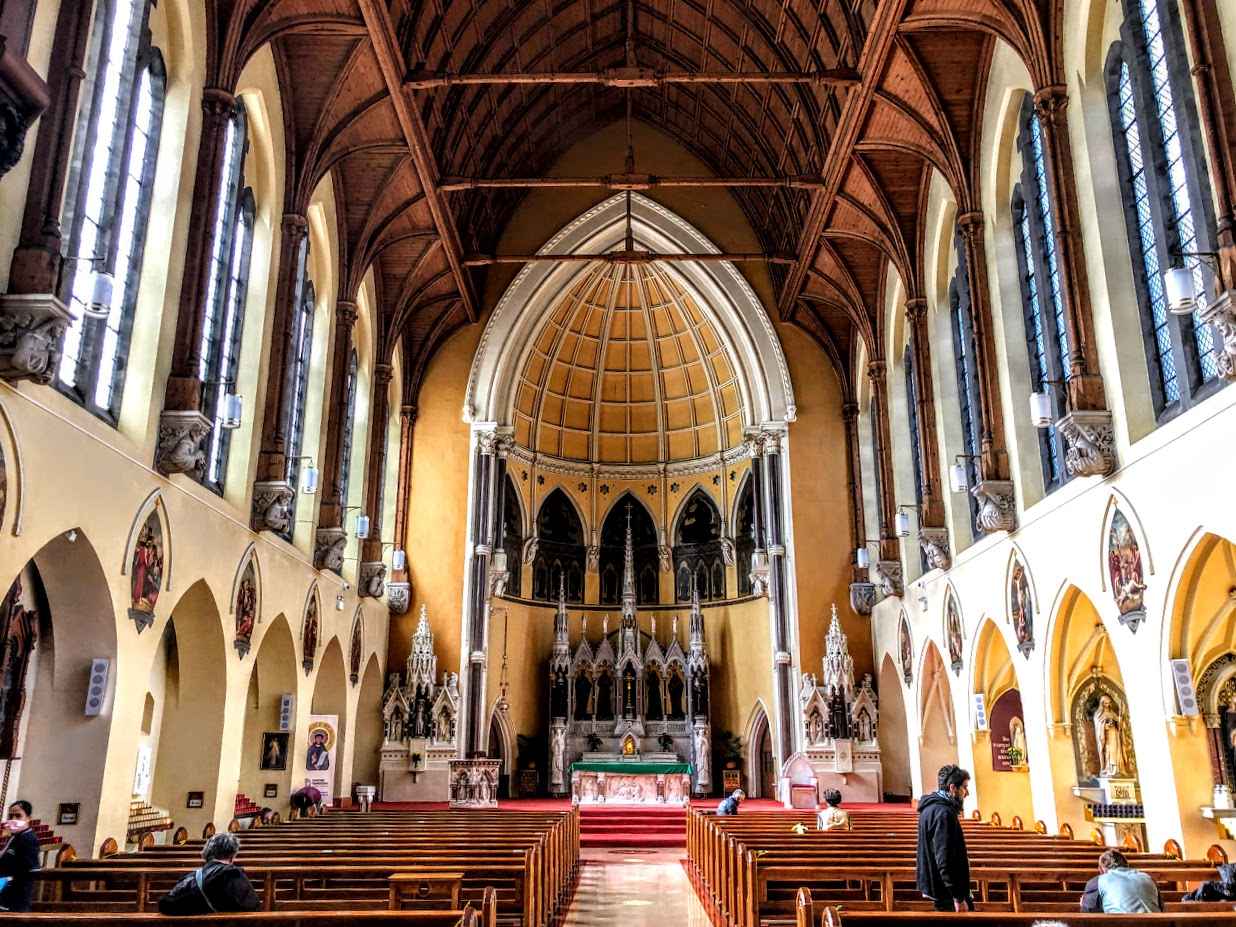
Inside the Church of Saint Mary of the Angels, facing liturgical east (Photograph: Patrick Comerford, 2021)
The Capuchins began as a reform movement within the Franciscan tradition in 1525. The Capuchin Friars first arrived in Ireland in 1615 and established their first convent in Dublin, on Bridge Street, in 1626. They moved to Church Street in the 18th century and, in 1796, built a simple chapel facing the street.
The Capuchin Church of Saint Mary of the Angels on Church Street, Dublin, faces the Father Mathew Square public housing estate. The church was named after a small church of the same name in Portziuncula, 2 km south of Assisi, where Saint Francis of Assisi died on the night of October 3, 1226.
Construction began in 1866, the foundation stone was laid on June 12, 1868, but the church was not completed until 1881. The church was dedicated on the Feast of Saint Francis, October 4, 1882.
The church was designed in the decorated Gothic style by James Joseph McCarthy (1817-1882), who saw himself as the architectural heir of A.W.N. Pugin in Ireland.
The Gothic style of the exterior is very impressive, with its large lancet windows and rose windows and statues with baldachins. The street-facing façade is constructed of limestone, finished with Portland stone, and the three pedimented entrances have high Portland stone caps.
The large pointed relief arch frames a rose window. Below it are two tall, double-sided windows in deeply molded frames, and a baldachin-clad statue of the Virgin Mary by Leo Broe, between two Franciscan saints, St. Francis and St. Clare, in the large lower arches at the outer ends.
Inside, the church is oriented on a west-west axis rather than the traditional liturgical east-west axis. It is a 10-arched nave with low, shallow side chapels and confessional niches, and a large pointed arch apse.
The interior is illuminated by tall triple lancets corbeled with dark limestone on the north and south walls.
There is a trefoil-profiled ceiling with large carved corbels of angels and saints.
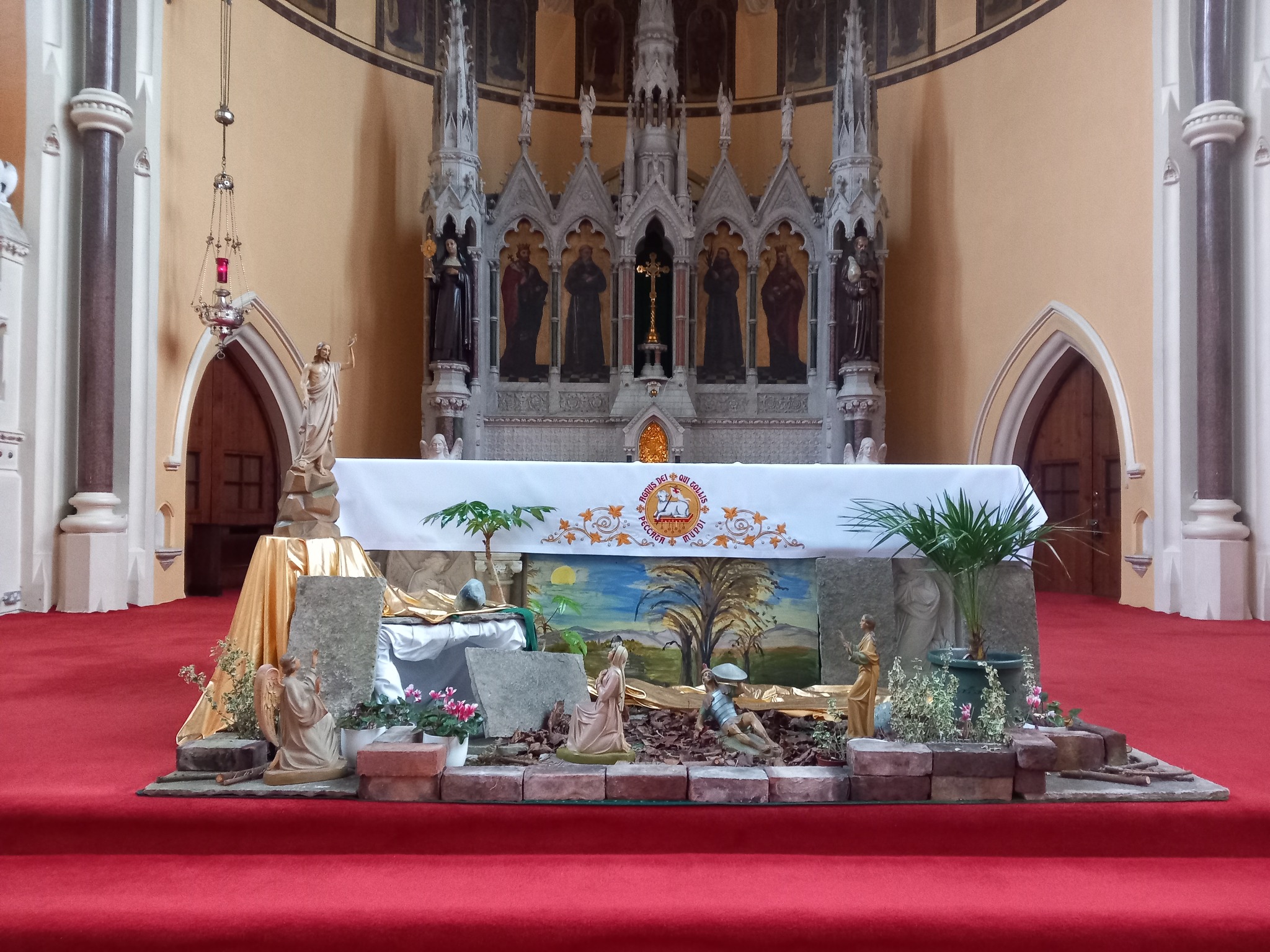
The high altar and altarpiece are by James Pearse (1839-1900), father of the 1916 leader, Patrick Pearse. The altarpiece depicts six Franciscan saints: Saint Clare, with a monstrance, Saint Louis of France, Saint Lawrence of Brindisi, Saint Fidelis of Sigmaringen, Saint Elizabeth of Hungary, and Saint Felix of Cantalice.
The Stations of the Cross, in mandorla form, are oil on canvas with inscriptions in Irish. The side altars are dedicated to the three patron saints of Ireland: St. Patrick, St. Brigid, and St. Columba.
The Third Order of St. Francis chapel was added in 1891, the gallery and choir in 1906, the shrine of St. Anthony of Padua in 1945, and the Grotto of Lourdes in 1950. A north aisle, added in 1910 by Ashlin and Coleman, now serves as an enclosed room and sacristy.
Father Mathew’s Hall, next to the church, and the adjacent monastery were built in 1881.
Today, the friars serve their local community through parish work and the Capuchin Day Centre, founded in 1969 by Brother Kevin Crowley. From humble beginnings in the convent gardens, it now provides over 700 meals a day and more than 1,500 food baskets every Wednesday for Dublin’s homeless and poor. Pope Francis visited the Capuchin Day Centre during his visit to Dublin in August 2018.
The Capuchin Missions Office supports the work of Irish friars in Zambia, South Africa, New Zealand and Korea.
St. Mary of the Angels is not a parish church, but the friars are responsible for Halston Street Parish, one of the oldest in Dublin city centre.
The Father Mathew Square housing estate, opposite the church, was designed in 1917 by JJ McCarthy’s son, Charles James McCarthy (1857-1947). It was named after the Capuchin temperance advocate, Father Theobald Mathew, who gives his name to the capuchin church in Cork [English].
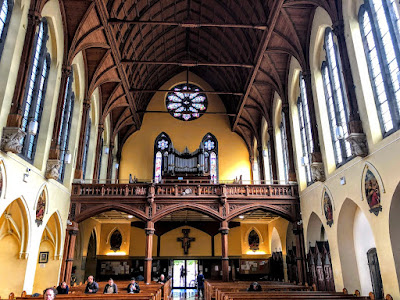
Inside the Church of Saint Mary of the Angels on Church Street, facing liturgical west (Photograph: Patrick Comerford, 2021)
© 2026 Brazilian Catholic in Dublin.